“If only I had known this was going to happen, I would have picked them up,” he told This Week in Asia, as social workers pressed government cash aid into his hands.
“I feel traumatised. I’m in shock and I still can’t accept what happened.”
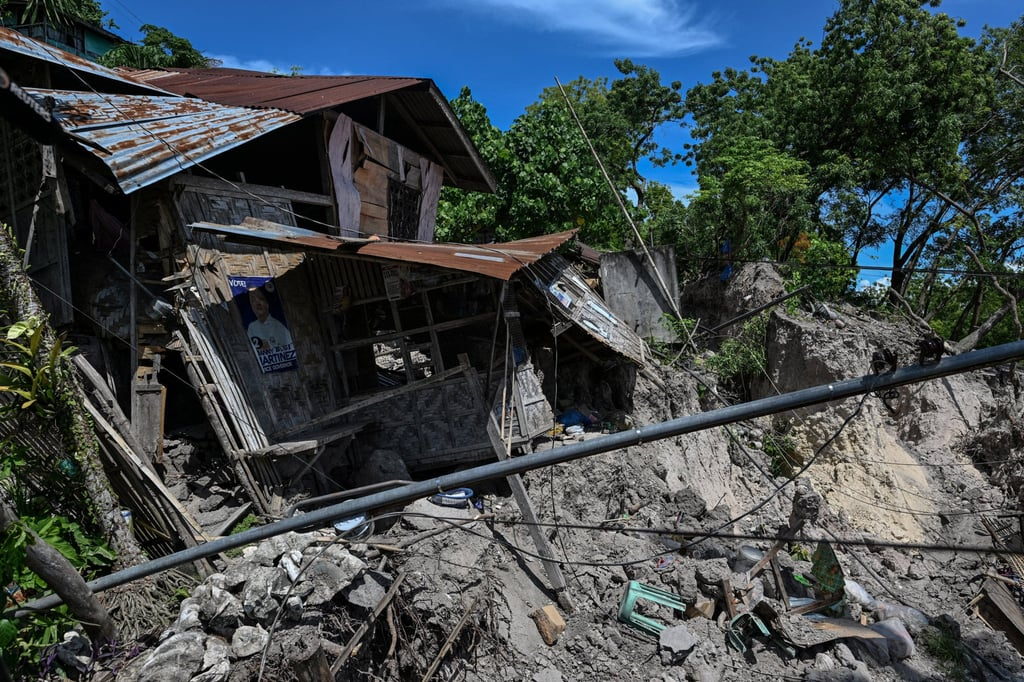
Nearly 68,000 homes were damaged or destroyed when the quake hit southern Mindanao on June 8. More than 1,300 people were injured and 33 are still missing.
The tremor triggered tsunami warnings along the southern coast and in neighbouring countries, as it crumpled schools and government buildings in General Santos, the largest and most populous affected city.
It should not have been this bad. The National Structural Code of the Philippines requires buildings to withstand a magnitude 8 earthquake – stronger than the one that struck.
“Under the structural code, buildings are supposed to withstand a magnitude 8 earthquake,” confirmed Office of Civil Defence spokesman Junie Castillo. “Where we need to catch up is in implementation.”
Castillo did not identify any buildings that may have violated construction standards, but the widespread damage in General Santos City and elsewhere in Mindanao has renewed scrutiny of building safety and enforcement.
Fear of the ‘Big One’
Disaster experts told This Week in Asia that the weakness lay less in the code than in inconsistent enforcement, poor compliance and limited awareness of disaster preparedness and risk reduction, particularly among policymakers.
“I believe that many private companies have retrofitted their buildings but I’m not sure about the government buildings,” said Rene “Butch” Meily, president of the Philippine Disaster Resilience Foundation, the country’s main private-sector coordinator for disaster risk reduction.
“I hope they’re aware and retrofitting, but I just don’t know.”
Meily said buildings constructed after 1991 were generally safer, having been built to updated standards introduced following the 1990 Luzon earthquake: a devastating magnitude 7.7 event that killed more than 1,600 people and caused widespread destruction across the Philippines’ main island.
But he warned that stricter rules meant little without stronger enforcement.
“It’s one thing to pass a law and another to enforce it. I hope developers everywhere are aware of their responsibilities and exercise greater care in the construction of their buildings,” Meily said.
“I can’t help worrying about what would happen if a major earthquake hit a large city, especially Metro Manila.”
Lessons from Tokyo
When a magnitude 9.0 earthquake struck in 2011, the devastation was widespread but most of Tokyo’s big buildings stayed standing, thanks to strict adherence to building standards, public awareness and “technologies such as base isolators, rollers and dampers that absorb seismic energy and reduce shaking”, Esguerra said.
“In the Philippines, buildings are often constructed too close together and safety considerations are not yet deeply embedded in our culture,” he said. “As a result, it is difficult to ensure building codes are consistently followed.”
Esguerra said inadequate public understanding of seismic and volcanic risk; cultural attitudes, including chronic non-compliance with evacuation orders; and a shortage of disaster risk reduction professionals and logistics all undermined the Philippines’ disaster preparedness.
“Taken together, these factors show why we are still not ready,” he said.
Decades-old laws
The legislative backdrop to last week’s disaster adds a particular edge of frustration.
In December, the House of Representatives approved House Bill No 6615, which would replace the outdated 1977 code with a New Philippine Building Act designed to strengthen structures against earthquakes, fires, floods, landslides, storms and volcanic eruptions. The Senate has yet to act.
Representative Miguel Luis “Migz” Villafuerte of Camarines Sur, a co-author of the bill, is hoping that a Department of Public Works and Highways review of the existing code will force the Senate’s hand.
“The review of the nearly 50-year-old NBC is a crucial step towards ensuring our infrastructure can withstand the growing threats posed by climate change,” he said.
Esguerra is cautiously supportive of the push, but clear-eyed about the limits of legislation alone.
“You can have strong regulations, but if people do not internalise the importance of preparedness and compliance, nothing will happen,” he said, noting that the Philippines consistently ranked among the world’s most disaster-prone countries.
“Changing that requires a broader shift in mindset and culture, so that future generations of leaders place greater emphasis on risk reduction.”
Meily’s conclusion was more ominous. “Nothing is truly earthquake-proof,” he said. “But structures can be designed and built to be far more earthquake-resilient.”
Article by Jeoffrey Maitem | South China Morning Post