The Philippine Disaster Resilience Foundation (PDRF), supported by the Australian Government through the Department of Foreign Affairs and Trade (DFAT), recently concluded Project REACHED (Resilient Emergency Communications for Enhanced Disaster Response) with a culminating activity that brought together partners from the national government, local government units (LGUs), and the private sector to celebrate accomplishments and discuss ways forward.
Australian Embassy in the Philippines First Secretary for Development Sarah Spencer said that the shared experiences and lessons from the project demonstrated the importance of investing in local preparedness and resilience. It highlights what is possible when government, communities, development partners, and the private sector collaborate.
Over the three-year program, Project REACHED delivered equipment and expertise to strengthen emergency communications in disaster-prone communities. It installed 224 pieces of communication equipment, including radios repeaters, Starlink units, satellite phones, drones, and power systems across 12 barangays in Butuan, Agusan del Norte; Virac, Catanduanes; Borongan, Eastern Samar; and Santa Ana, Cagayan. Additionally, 200 disaster risk reduction and management (DRRM) personnel were trained in emergency communications, drone operations, and rapid damage assessment. Each municipality was also provided with three sets of PLDT-SMART Ligtas Kits. These efforts were made possible with the help of implementing partners: the Office of Civil Defense (OCD), the Department of Information and Communications Technology (DICT), PLDT-Smart, Globe, and the World Food Programme (WFP).
The real-world impact of this initiative has already been tested, as PDRF President Butch Meily recalled. “During Typhoon Nando, a boat capsized. Thanks to the radio and Starlink equipment provided by REACHED, the crew members on that boat were rescued,” he said.
According to DICT DRRM Division Chief Rafael Olivar, the equipment enabled DRRM offices at the provincial, municipal, and barangay levels to connect directly to the regional and national operations center. This created end-to-end emergency communications enabling coordinated response. In addition, Project REACHED helped shape the national emergency communications plan by defining and including the private sector’s role in the framework.
“That’s the power of the network,” said PDRF Chief Resilience Officer Guillermo Luz. “If we can link up to our municipalities, our city halls, our regional centers, all the way up to OCD and the National DRRM Council, we can be much more effective at disaster preparedness, prevention, and response,” he added.
This network effect, leaders emphasized, is what multi-sector collaboration makes possible. In his message of support, OCD Deputy Administrator for Administration Bernardo Rafaelito Alejandro IV praised the project as “a compelling example of how effective public-private and multi-sector partnerships can strengthen disaster preparedness and response capacities,” adding that “resilience is not built by a single institution alone but through collective action, shared responsibility, and a common commitment to protecting lives, livelihoods, and communities.”
To ensure continuity and replicability of this initiative, the project also launched its manual, a comprehensive, practical, and user-friendly resource that will guide LGUs and all stakeholders through each phase of project implementation. The manual supports the systematic and effective execution of program activities and gives communities a reference on emergency communications they can use long after the program ends.
The event also featured a panel discussion moderated by the PDRF Operations Center Director and the project’s Director, Arnel Capili, which drew insights from Help.NGO, WFP, and DICT. Panelists emphasized the shift from one-way information dissemination to community-centered, two-way communication systems that enable affected populations to actively participate in disaster response and recovery. They also discussed the deployment and localization of DICT’s Government Emergency Communications System-Mobile Operations Vehicle for Emergencies (GECS-MOVE), efforts to expand emergency communications infrastructure across hazard-prone areas, and plans to institutionalize training and certification for emergency telecommunications operators.
Moreover, local chief executives of the project sites shared how improved connectivity has enhanced disaster preparedness and response during recent typhoons, as well as access to education and essential services in remote communities. They also expressed their commitment to sustained use of equipment and continued investment in emergency communications infrastructure in their localities.
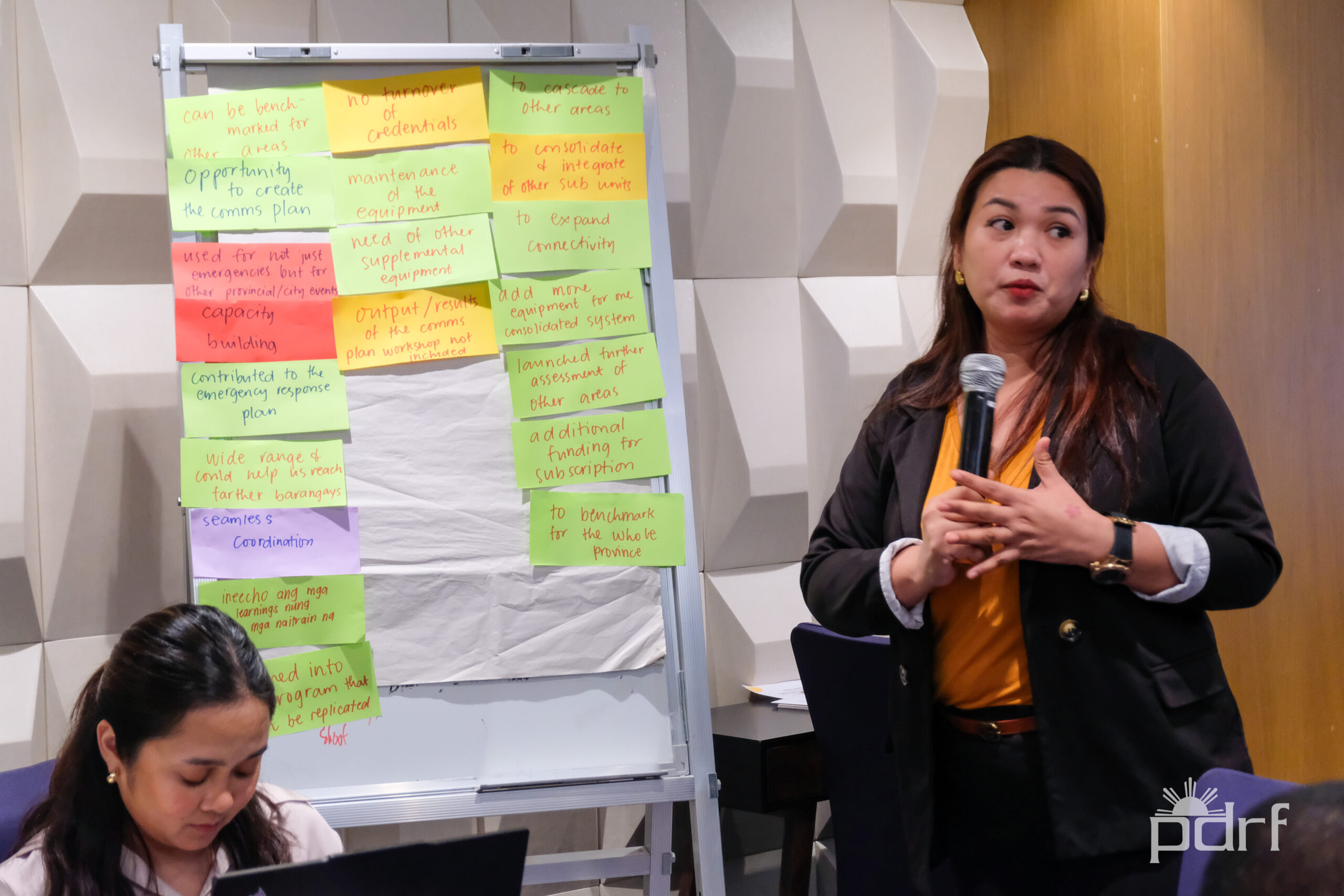
Building on the discussions, LGU participants gathered for a workshop to identify lessons learned, chart ways forward, and explore how the project can be improved and scaled up. They also discussed pathways to extend coverage to more LGUs, deepen integration with national systems, and institutionalize the gains the project delivered.