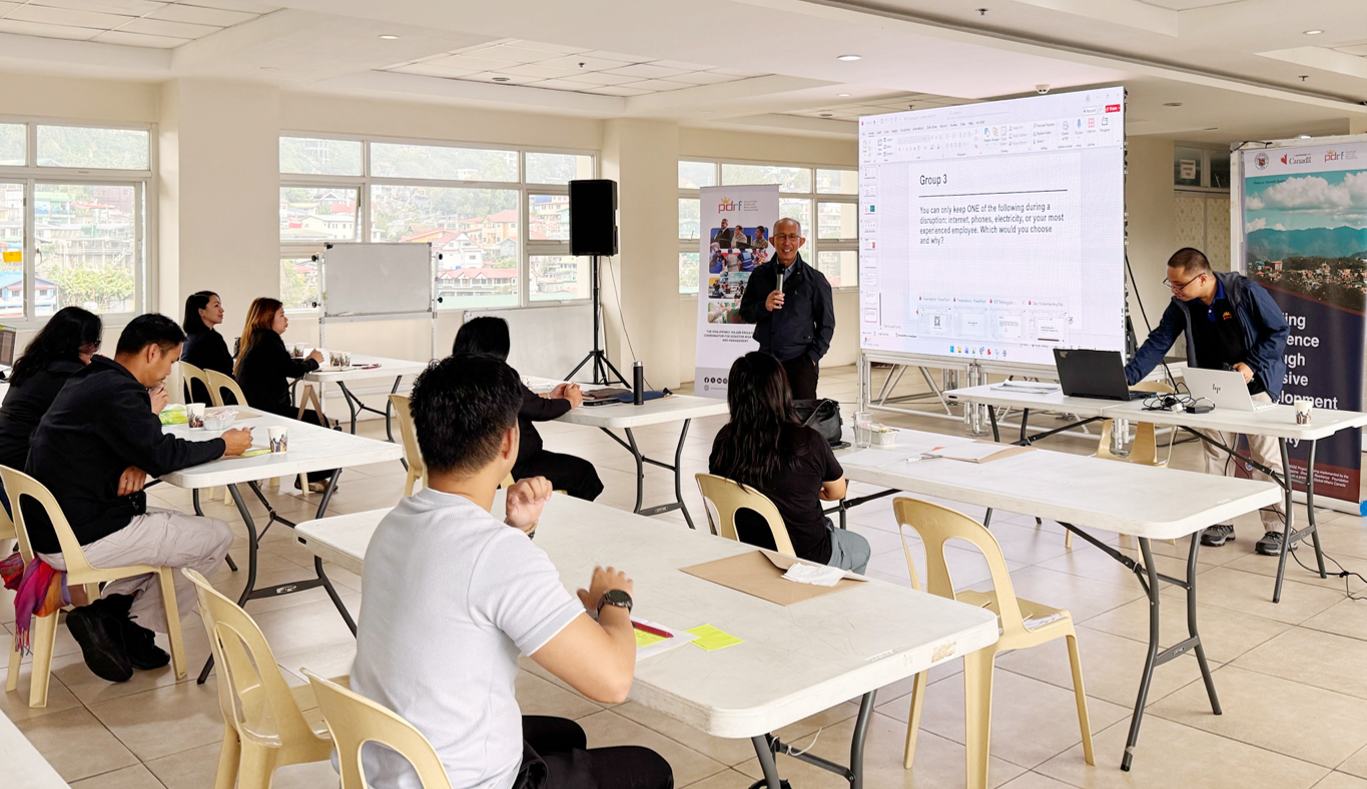
The Philippine Disaster Resilience Foundation (PDRF), through its Building Resilience through Inclusive Development and Gender Equality (BRDIGE) Project and in partnership with the Baguio City Government through the City Disaster Risk Reduction and Management Office (CDRRMO), conducted a Business Continuity Management (BCM) training for the medium enterprises in the local retail, food and beverages, tourism and academe sectors on June 23-25, 2026.
“Resilience is a shared responsibility, and real progress can only be achieved through strong collaboration among government, businesses, academic institutions, and community stakeholders,” said Baguio City Mayor Benjamin Magalong, underscoring the significance of capacitating the local economic industry key players to advance Baguio City’s climate resilience and development goals.
A total of 33 representatives from the local retail, food and beverages, tourism, and academe sectors and the local government unit participated in the three-day training which covered core concepts of Business Continuity Management (BCM) and its importance in the participants’ respective sectors. The training also served as a venue for the participants to conduct basic risk assessment and business impact analysis (BIA) for their respective organizations. Aligned with the City’s Economic Continuity and Resiliency Plan, each session integrated sector-specific scenarios, tools, and exercises relevant to the unique operational risks faced by key economic drivers of Baguio City. Through this training, the participants were able to draft the key components of their own Business Continuity Plan, including response, recovery, and communication strategies.
“Through effective business continuity planning, Baguio City can minimize risks, protect investments, and build organizations that are better equipped to withstand adversity,” said Mayor Magalong. He also emphasized that this workshop is an important step toward strengthening the City’s capacity to ensure continuity of operations while safeguarding livelihoods, services, and communities.
Crucially, the training connected business continuity with the city’s unique environmental challenges, particularly its vulnerability to water stress.
“For a water-stressed area like Baguio, a business continuity plan isn’t just about recovering from a disaster; it’s about adapting to everyday climate realities and resource shortages. By equipping these enterprises with practical continuity strategies, we are protecting local livelihoods and building a more inclusive, sustainable, and resilient economic foundation for the city,” said BRIDGE Project Director Anna Katrina Aspuria.
Engaging these commercial sectors is essential for promoting a multi-stakeholder approach to integrated water resources management (IWRM). By involving heavy water users—like tourism and F&B—in resilience planning, the City can better manage its resources during climate-induced disruptions.
BRIDGE is a four-year project implemented by PDRF with the funding support from Global Affairs Canada to improve the disaster and climate resilience of water-stressed communities in Baguio by strengthening public-private partnerships and advocating for gender-responsive, climate-resilient resource management.