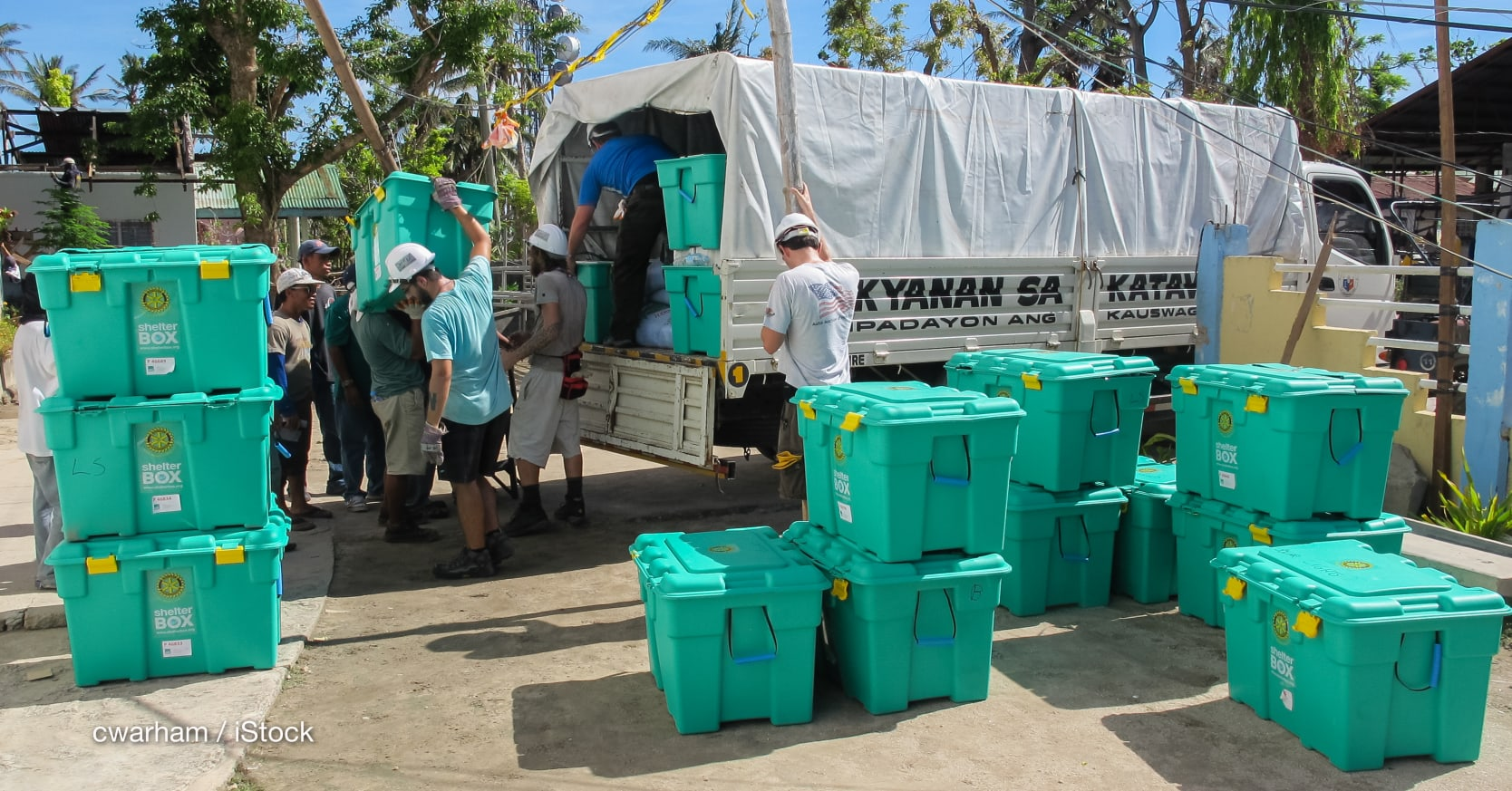
A decade after the Grand Bargain committed the humanitarian sector to shifting power, resources, and decision-making closer to affected communities, few would dispute that localization matters.
Yet the gap between commitment and implementation remains stark. In 2024, just 3.6% of humanitarian funding went directly to local and national players, far below the Grand Bargain’s original 25% target.
But funding tells only part of the story.
Overcoming constraint by design
Across much of Asia-Pacific, humanitarian supply chains remain structured around international systems. Relief items are procured through global framework agreements, procurement authority is concentrated outside affected communities, and coordination mechanisms largely activate in response to emergencies rather than operating as standing preparedness structures. Local suppliers, logistics providers, and national institutions have limited influence over the systems and decisions that shape preparedness and response.
That challenge sits at the heart of “Local by Default: Building Resilient Humanitarian Supply Chains in Asia-Pacific,” a new supply chain reform brief developed through the HELP Logistics Thought Leadership initiative.
One of its central findings is that localization is constrained not only by local capacity, but by the humanitarian system’s own design. Fragmented coordination, constrained national leadership, procurement rules, institutional incentives, and weak connections to domestic markets can all make international sourcing the easier default, even where local capabilities exist.
None of this diminishes the fundamental power question at the heart of localization. Who controls resources, who makes decisions, and who carries risk still matter.
But supply chains are one of the places where those power relationships become operational: Procurement rules determine who can compete. Contracts determine where resources flow. And coordination structures shape who participates in decisions.
Take tents as an example. India and Pakistan both manufacture and export tents, with Pakistan operating a particularly significant export industry. Yet humanitarian organizations do not always have the precrisis market intelligence needed to determine whether domestic manufacturers can meet required specifications, volumes, and delivery timelines.
That does not mean a locally manufactured tent automatically meets humanitarian specifications. But it raises an important question: Do we know whether it could?
Before an emergency, humanitarian organizations should already understand what domestic manufacturers can produce, at what quality, in what quantities, at what cost, and with what lead times. Where suppliers do not yet meet required standards, we should understand what would be needed to close that gap.
Preparing for a crisis closer to home
The consequences become clearer when crises overlap.
When the Palu earthquake and tsunami struck Indonesia in September 2018, only weeks after the Lombok earthquakes, stocks of critical relief items such as tarpaulins had already been drawn down. Yet humanitarian groups lacked a sufficiently clear picture of what Indonesian manufacturers could produce and how quickly they could respond.
That knowledge cannot be built in the middle of an emergency. Supplier mapping, market intelligence, relationships, and coordination have to be developed before they are needed.
Localization begins long before the first relief truck leaves the warehouse.
Preparedness is therefore not separate from localization. It is one of the conditions that makes localization operational.
The encouraging news is that Asia-Pacific is not starting from scratch.
In the Philippines, the Philippine Disaster Resilience Foundation has connected more than 70 private-sector partners through a standing preparedness platform. Across the Pacific, the Pacific Humanitarian Warehousing Program is strengthening national warehousing systems in 14 countries, demonstrating how regional systems can support localization where individual domestic markets are constrained.
These examples reinforce an important qualification: Localization cannot mean the same thing everywhere.
Asia-Pacific encompasses large economies with significant manufacturing capacity, small island states with constrained domestic markets, and fragile or access-constrained contexts where regulation, sovereignty, sanctions, and geopolitics shape what is possible.
Nor does local by default mean local only.
International supply chains remain essential where local markets cannot meet required volumes or standards, where disasters disrupt domestic supply, or where global sourcing offers clear operational advantages.
The goal is a system that deliberately draws on local, regional, and international capabilities according to context.
Moving from principle to practice
Making this shift operational requires changing some of the rules that govern how humanitarian supply chains work.
The supply chain reform brief identifies customs preclearance and tax and duty relief for replenishing pre-positioned humanitarian supplies outside declared emergencies as immediately actionable reforms. Without appropriate arrangements in place, organizations can face additional costs when replenishing supplies in preparation for the next disaster.
Removing barriers like these is how localization moves from principle to practice. It creates the conditions for national institutions, local markets, and humanitarian organizations to prepare before a crisis rather than negotiate solutions once it has begun.
Localization will not become operational through commitments alone.
It will happen through decisions about procurement rules, market intelligence, customs procedures, coordination, national leadership, and who has the authority to act before a crisis strikes.
The humanitarian community has spent much of the past decade establishing why localization matters.
The next chapter must focus on changing the systems that make it possible.
Because if we want humanitarian response to be local by default when disaster strikes, we have to build the conditions for it long before the emergency begins.
Article by Mahdi Bayat, Colin Wee, Dina Bokai | Devex