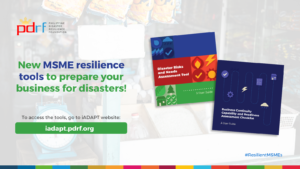
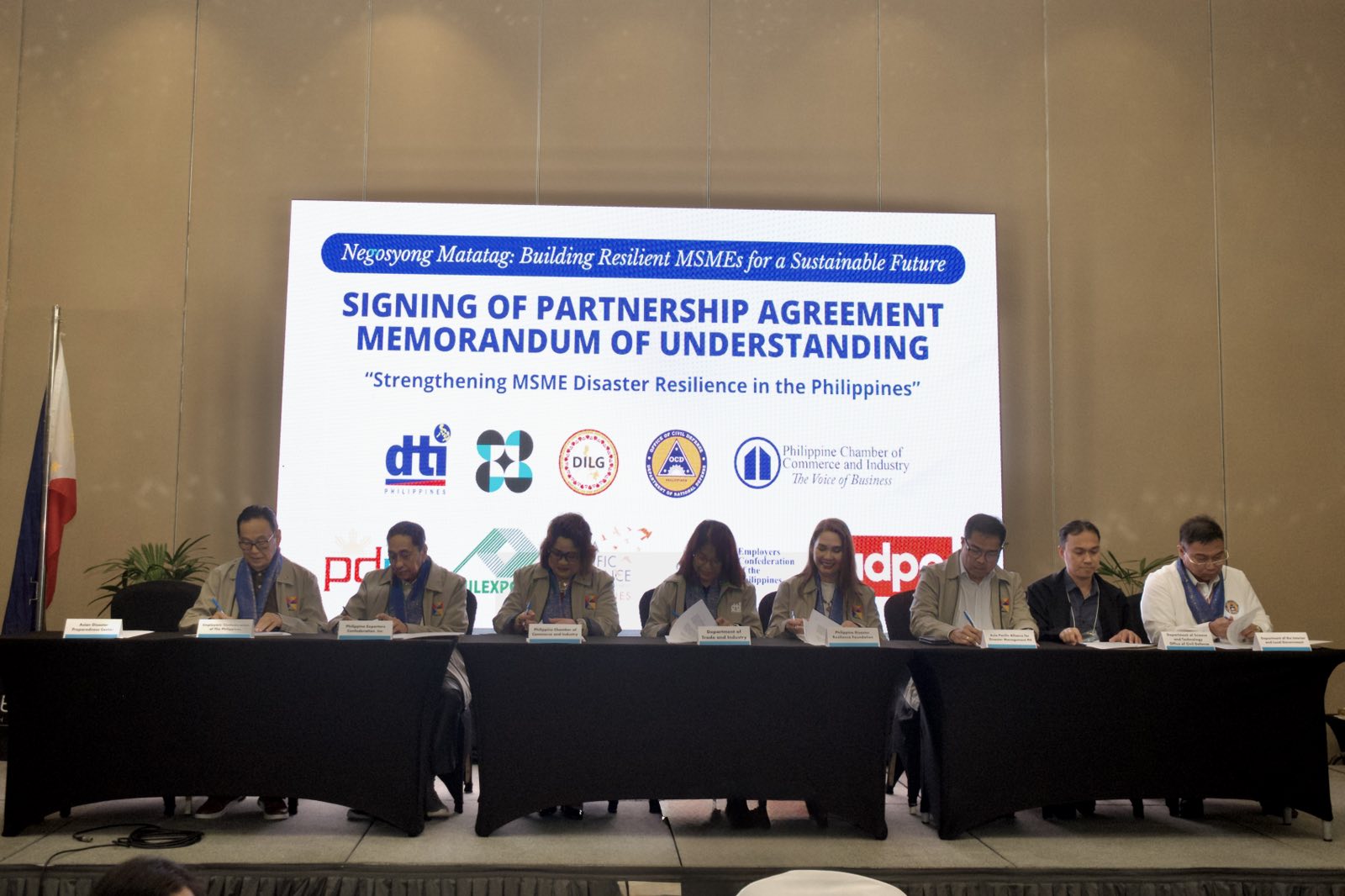
The Department of Trade and Industry (DTI) and nine government, business and development organizations have signed a memorandum of understanding (MOU) to strengthen disaster resilience among micro, small and medium enterprises (MSMEs) through a coordinated national roadmap on business continuity and disaster preparedness.
Joining the DTI in the agreement are the Department of Science and Technology, Office of Civil Defense, Department of the Interior and Local Government, Philippine Chamber of Commerce and Industry, Philippine Disaster Resilience Foundation, Philippine Exporters Confederation Inc., Asia Pacific Alliance for Disaster Management-Philippines, Employers Confederation of the Philippines and the Asian Disaster Preparedness Center.
The initiative, dubbed “Strengthening MSME Disaster Resilience in the Philippines,” aims to develop and implement policies, strategies and programs that will help businesses prepare for, respond to and recover from natural disasters and other hazards.
Under the agreement, the participants will develop a national roadmap on MSME disaster resilience that will serve as a framework linking government agencies, private sector organizations and development partners to institutionalize mechanisms that support business continuity before and after disasters.
The collaboration will focus on raising awareness and building the capacity of MSMEs on business continuity management and business continuity planning, promoting knowledge sharing on disaster risk management, engaging more stakeholders in resilience-building initiatives, supporting the implementation of the Sendai Framework for Disaster Risk Reduction, and developing standards and monitoring guidelines for the MSME Resilience Core Group.
The partners also agreed to exchange technical expertise and research, jointly organize training programs, workshops and seminars for MSMEs, and pursue project-specific collaborations through separate agreements.
The MOU recognizes that MSMEs are among the most vulnerable sectors during disasters and that improving their preparedness is essential to sustaining economic activity, protecting jobs and strengthening supply chains.
Quoting an international report, Leonila T. Baluyut, DTI Assistant Secretary for Regional Operations Group, said four out of every 10 MSMEs never reopen after a major disaster, underscoring the need for businesses to adopt continuity plans and invest in disaster preparedness.
Baluyut said that 40 percent of small businesses permanently close after a major disaster, while another 25 percent cease operations within a year, highlighting the sector’s vulnerability to natural hazards.
“The greatest risk to our MSMEs is no longer the disaster itself. It is facing the next one unprepared,” Baluyut said.
She said the Philippines’ exposure to typhoons, earthquakes and volcanic eruptions makes resilience a business imperative rather than an option.
The Philippines ranked first globally in disaster risk under the 2024 World Risk Index. About 20 tropical cyclones enter the country’s area of responsibility annually, while its location along the Pacific Ring of Fire leaves communities and businesses exposed to earthquakes and volcanic activity. / KOC
Article by Katlene O. Cacho-Laurejas | Sunstar Cebu