The Philippines has plenty of water, yet many families, cities, and businesses still face shortages, floods, and unreliable supply. To close that gap, the Philippine Disaster Resilience Foundation (PDRF) recently brought together national agencies, local governments, water utilities, and its member companies for Cluster Connect: Public-Private Collaboration for Water Resilience in Makati City. The event also marked the official launch of the Building Resilience through Inclusive Development and Gender Equality (BRIDGE) Project, a four-year initiative implemented by PDRF and funded by the Government of Canada to strengthen water management and climate resilience in Antipolo City and Baguio City.
Water problems in the Philippines come from many directions at once: changing weather patterns, damaged watersheds, fast-growing cities, rising demand, and gaps in infrastructure. Many agencies, local government units (LGUs), and private groups are already working to address these challenges, but these efforts are not always aligned or coordinated. Cluster Connect, an annual gathering of PDRF’s cluster members to strengthen private sector coordination and align with the country’s resilience agenda, aims to bring these efforts together into a coordinated approach where the government sets direction, LGUs lead on the ground, and business brings resources and expertise.
“Canada is proud to support the Philippines’ efforts to strengthen water security, recognizing that access to safe, reliable, and sustainable water resources is essential for healthy communities, economic growth, and climate resilience. Canada’s experience has shown that sustainable water solutions are built through strong partnerships across government, the private sector, and communities, bringing together policy leadership, innovation, technology, and investment.” said H.E. David Hartman, Ambassador of Canada to the Philippines.
In his keynote address delivered by Department of Environment and Natural Resources Undersecretary Ignatius Rodriguez, Secretary Juan Miguel Cuna called for stronger public-private action on water. “Businesses can improve water-use efficiency, reduce avoidable losses, explore water reuse where appropriate, and incorporate water-related risks into operational and investment decisions. Corporate initiatives can also contribute to the protection of our water resources. Private-sector innovation, technical expertise, and data can help advance national and local water-security priorities, particularly where these capabilities can support ongoing government efforts,” he said.
Special Envoy of the President for Disaster Risk Reduction and Management Maria Antonia Yulo-Loyzaga emphasized how water security is connected to the country’s disaster preparedness efforts. “The nature and dynamics of both convergence and emerging risk require shared insight and perspectives, knowledge, and a timely and appropriate use of advanced science and technology, analytics-aided engineering systems, science informed government approaches. The government alone cannot address the magnitude of our challenges. We need partnerships that bring together the complementary strengths, resources, and capabilities of different sectors. This is where the private sector and international partners matter most,” she said.
“Clean water is a right. Its availability and use are critical for both communities and businesses. PDRF, through the BRIDGE program, is trying to address the issues with the help of the water concessionaires, local governments, and others, focusing on the needs of women and indigenous people,” said PDRF President Rene Meily.
The event also held two panel discussions focused on how government, businesses, and communities can work together to address water and climate risks through practical solutions.
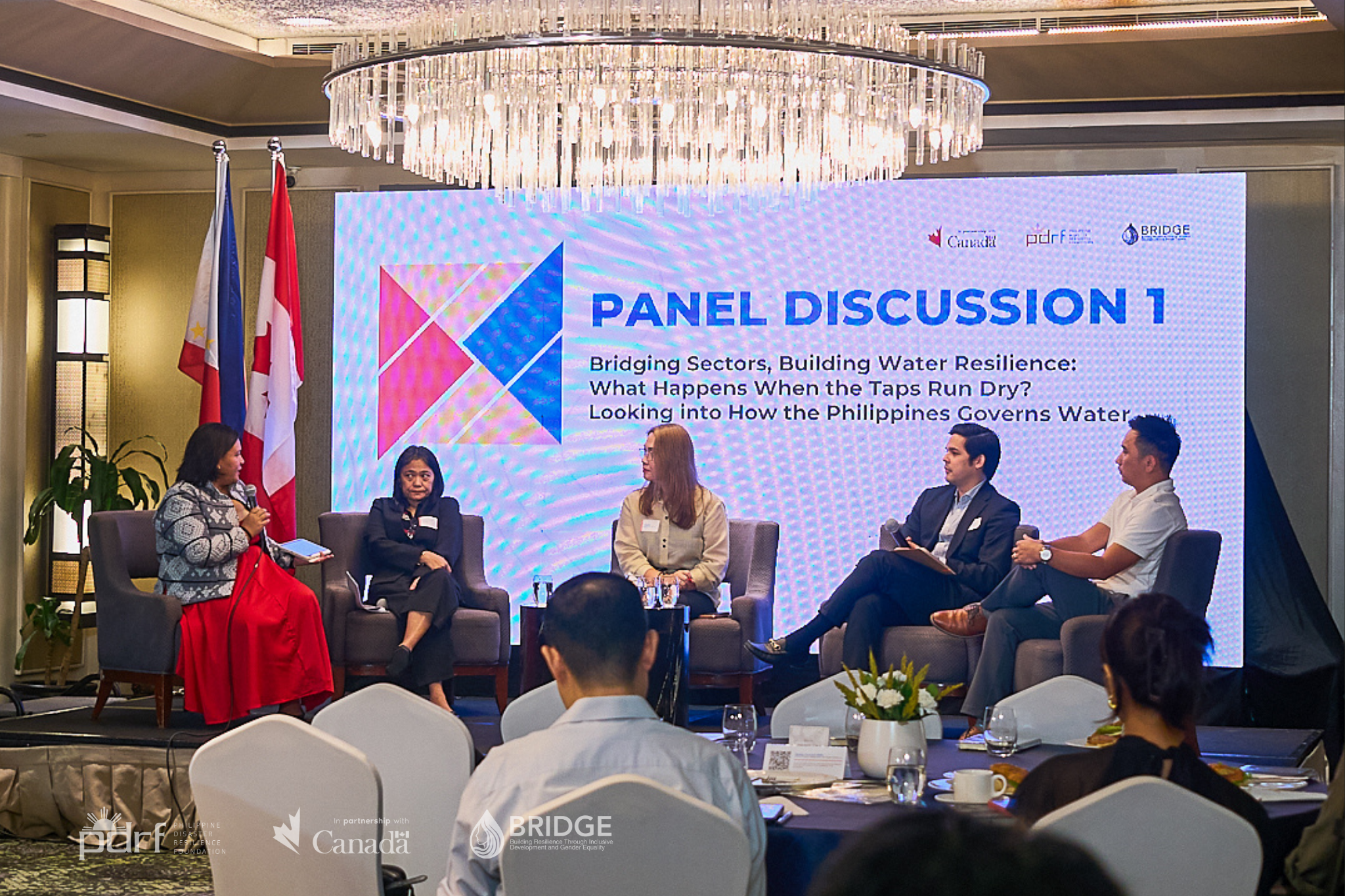
The first panel, moderated by BRIDGE Project Director Anna Katrina Aspuria, included national and local leaders and tackled how the country can move from fragmented water programs to a coordinated, whole-of-society approach to water security.
OIC of the Policy and Program Division of the National Water Resources Board, Engr. Josephine Billones called for stronger support for LGUs to gather more on-the-ground data to address issues. Antipolo City Vice Mayor Roberto Andres Puno and Baguio City Environment and Parks Management Office Head Atty. Rhenan Diwas shared how water challenges play out on the ground and what their cities have learned from managing water and planning for resilience. Baguio and Antipolo are implementing partners of the BRIDGE Project.
“Public-Private Partnership is crucial for Baguio City’s water security. Some environmental challenges can be resolved through fragmented, smaller annual programs, but immediate issues like water security require an ambitious solution. That can only be done when the government taps into the support of the private sector,” said Atty. Diwas.
“We are approaching 1 million people in terms of population, so the demand for water and wastewater services is always there. A lot of the issues come with simply not having enough resources to tackle these issues. We’re in need of personnel who are specially trained; we’re in need of data, feasibility studies. These are all of the things that the city would need to fill in the gaps with their expertise,” said Vice Mayor Roberto Andres “Randy” Puno Jr., emphasizing the need for collaborations with the private sector in initiatives that directly contribute to addressing gaps in the capacities of local institutions.
The second panel, moderated by BRIDGE Project Manager EnP. Alex Czar Masiglat, highlighted how the private sector already supports public efforts during a water crisis. Manila Water President and CEO Roberto Jose Locsin and Maynilad President and CEO Ramoncito Fernandez shared what it takes to keep water flowing to millions of households during typhoons and dry spells, and the concrete sustainability efforts they are championing. Philippine Business for Social Progress Executive Director Elvin Ivan Uy discussed how businesses can work with communities to bring safe water to underserved areas.
Underscoring the importance of directing international support toward underserved and far-flung communities, Locsin said, “I would like to see international partners focus on building local capacity and putting in place the fundamental structures that will enable investments to deliver lasting benefits, even beyond the grant period. This is how we can strengthen water resilience in micro-communities across the Philippines.”
“For Maynilad, sustainability is not just about protecting our water resources, but also about creating opportunities and improving lives in the communities we serve. Our partnership with the Dumagat communities reflects this approach. We provide livelihood opportunities, while they help protect our water sources through tree planting and maintenance. It is a mutually beneficial partnership that supports both watershed protection and community development. We apply the same principle of partnership in bringing water services to underserved communities. Through Samahang Tubig Maynilad, we help low-income communities organize local water associations to facilitate access to affordable water services. Through our Pag-asa sa Patubig Partnership, or P3, we collaborate with social enterprises to extend water services to underserved communities, including informal settlements. These initiatives demonstrate how working with communities can create lasting benefits for both people and the environment,” said Fernandez, elaborating on how Maynilad integrates sustainability in their business operations by partnering with the communities.
The discussion carried added urgency as the anticipated impact of El Niño on water supply and business operations increased. PDRF briefed its member companies and partners to support their preparedness and response decision-making.
PDRF member companies joined a Partnerships Lab to match their assets, data, and expertise with what LGUs and national agencies need to manage water resources. They identified shared risks that no company can solve alone, including water scarcity, flooding, and supply chain disruption. They also explored joint solutions such as pooled financing, shared data, and co-built infrastructure, and discussed forming a private sector consortium on water resilience.
Insights and commitments from the event will feed into the Private Sector Engagement Roadmap for Integrated Water Resources Management, which PDRF is developing under the BRIDGE Project.