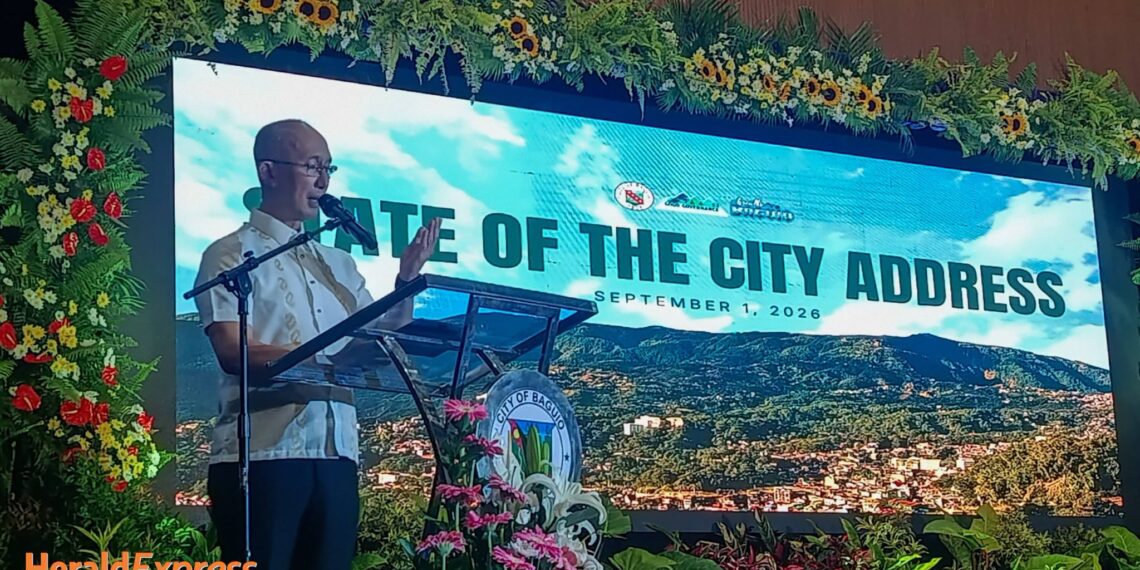
People are aware of the city’s challenges and that there is still much work to be done, but the local government knows what the city is capable of when its people come together with purpose, Mayor Benjamin B. Magalong said here Tuesday.
In his State of the City Address (SOCA) delivered during the 117th Baguio Charter Day program, the mayor outlined the gains of the local government over the past several years that warrants the people to raise the standards, continue to demand better from government and from themselves, and never settle for anything less than the Baguio they know it can become.
He said that the three dimensions of the city’s vision, livability, creativity and inclusivity, guide the transformation journey where livability aims to create a safe, resilient, healthy and sustainable environment; inclusivity ensures equitable access to opportunities, services, and meaningful participation; while creativity fosters innovation, entrepreneurship, culture, and new solutions that enable the city to continuously adopt and thrive.
“We continue to pursue governance that is sustainable, participative, and accountable. We cannot continue to deliver and expand services without the resources to support them,” Magalong stated.
He claimed that the local government’s revenues grew by 14.4 percent in 2025, from P2.63 billion in 2019 to P3 billion. As of July this year, the city was able to collect P2.25 billion that seeks to sustain tis year’s budget of P3.65 billion with 62 percent already utilized as of last month.
Further, the local chief executive reported that the city’s economy continues to grow where in 2024, Baguio’s economy expanded by 5.8 percent, from P169.02 billion to P178.85 billion, which is already P26.09 billion above its pre-pandemic level.
According to him, the local government needs to strengthen its local revenue base where it started with the garbage fees through Ordinance No. 69, series of 2026, not only to help support the cost of waste management, but also to change how people deal with their waste. The city’s long-term goal is to reduce waste generation by 20 percent through the expansion of the city’s circular economy program.
Earlier, the local government adopted and established the Pansa-Nopen Tayo Circular Economy framework through Ordinance No. 15, series of 2026 which brings the circular economy into the city’s policies and programs, and more importantly, down to all 128 barangays, so that reducing waste and using resources responsibly becomes part of how people operate.
Moreover, he noted that materials recovery systems (MRFs) are being established in six barangays as pilot sites while a modern waste processing facility is now being constructed, and an inclusive cooperative model involving women, youth, and waste workers is in place to ensure that vulnerable sectors participate and benefit from the transition.
Last June, the city launched the Pansa-Nopen Tayo Circular Economy Resource Book for Basic Education, which provides the schools with actual lessons and activities that they will include in their curriculum as the city wants the children to grow up understanding that waste reduction, reuse, recycling, and responsible consumption should already be part of everyday life.
On the other hand, Magalong stipulated that the United Nations Development Program (UNDP) and the European Union (EU) had been the city’s partners in all of the aforesaid initiatives for over a year now.
He expressed the city’s heartfelt gratitude to both the UNDP and the Eu for their continued support and guidance and that the local government is blessed to have partners like them.
He admitted that Baguio has lived with water shortages for many years but with the city’s growing population, increasing demand, and the effect of climate change, the local government cannot allow the said problem to become even more difficult for the next generation.
British consultants through the Green Cities, Infrastructure and Energy Program have been working with the city and the Baguio Water District on a feasibility study for the city’s long term water supply where such technical assistance is a grant from the United Kingdom (UK) government amounting to around 2 million pounds.
He disclosed that the said study has already been completed and turned over to the city just last month. The study found that by 2055, Baguio could face a water supply gap of at least 117 million liters per day and that it assessed eight possible sources and looked at the technical, financial, environmental, social, and climate considerations of each option, giving the city a much stronger basis for the decisions the local government has to make moving forward, instead of simply choosing a project and hoping it works, it also gives the city a clearer path towards securing approvals, attracting investments, and eventually putting in place a water supply system that can serve the city for decades.
At the same time, the local government is also strengthening how the city manages the water resources that are already existing aside from working with the Philippine Disaster Resilience Foundation through the BRIDGE project, with support from the Canadian government. It is a 4-year program that focuses on integrated water resources management, where the city intends to look at the entire water system, from watersheds and groundwater sources to how water is used, protected, and managed by the communities and institutions.
Magalong emphasized that the project will help the city strengthen watershed protection, improve planning and policies, build the capacity of the barangays and city offices, and use better data for decision-making. It also looks at the needs of water stressed communities and how climate change and disasters can further affect the city’s water supply.
The mayor said that the city continues to get support from foreign governments and foundations because after due diligence, they confirmed that Baguio has embraced the principle of good governance.
At the same time, the city was a able to identify some five new sites for housing development, Irisan Pansa-Nopen village, Asin housing village, GSIS Property near the Baguio Convention Center, PNR property in Marcoville, and the DICT compound in Quezon Hill. Aside from the said sites, the city continues to develop the Luna Terraces where the local government is closely coordinating with affected residents, developers, housing agencies and other partners as the city works through the requirements of each site.
In March, Baguio was designated by the United Nations Office for Disaster Risk Reduction as a Resilience hub under the Making Cities Resilient 2030 initiative where Baguio is only the second city in the country to receive the said designation, 4th in Southeast Asia, and 7th in the Asia-pacific. Being resilience hub means that Baguio now takes on a larger role in pursuing its resiliency programs and helping other cities strengthen their own resilience.
Subsequently, Baguio continues to build on MINERVA which was turned over to the city two years ago, continues to provide data and predictive analytics on air and water quality, mobility, and tourism demand that allows the city to better understand the impact of its policies and programs before implementation.
He argued that the local government also launched the enhanced Baguio In My Pocket Plus, bringing more city services and information into one digital platform. The city seeks to continue building systems like the earlier ones so that overtime, dealing with the local government becomes simpler, faster and accessible.
Magalong also noted that the local government is issuing digital systems to strengthen transparency and accountability and that through the PRISM, the public can view city-funded infrastructure projects, their budgets, and their progress from planning up to completion. Residents can also report concerns and upload photos directly through the platform, allowing them to take part in monitoring how projects are implemented.
He asserted that with the said systems in place, there is no question about the city’s direction towards more open and transparent governance. The city established its own open data portal pursuant to the draft open data policy using the global Open Data index as a guide.
The local government institutionalized the Kapihan sa Barangay where the city meets with residents, hear the issues and bring the appropriate city offices into the dialogues so concerned officials can act on their concerns immediately.
“We cannot expect all of these reforms to last of city hall itself does not change and transform. If we want these reforms to continue across administrations, then we have also to strengthen the institution to carry them forward,” Magalong said.
Through the Performance Governance System (PGS), the city strengthens how it plans, executes, and measures its strategies. Baguio was already able to complete the initiation and compliance stages where the city received the Silver Trailblazer Award for both stages. The city is now working towards the third and fourth stages, proficiency and institutionalization.
The local government continues to strengthen its ISO 9001:2015 quality management system. Last march, the city underwent a 5-day re-certification audit covering the departments and services and that it successfully passed which tells the people that the systems and processes that have been put in place continue to meet international standards, but more importantly, it keeps the local government disciplined in reviewing and improving the way they work.
The city was also able to access technical assistance in the amount of one million pounds from the British government to pursue ISO 37001 which is the international standard for anti-bribery management system. Last month, the road map that will guide the city towards the said certification had already been turned over to the city.
Through the Emerging Leaders Program (ELP), the city continues to develop the next generation of leaders to manage the local government where two training sessions had been completed since the implementation of the program in 2025.
Magalong underscored that the most significant legacy that the city will leave behind s change in mindset about public service, that it should never be linked to politics, nor should it be linked to a certain office, political alliance or individual.
Article by Dexter See | Baguio Herald Express