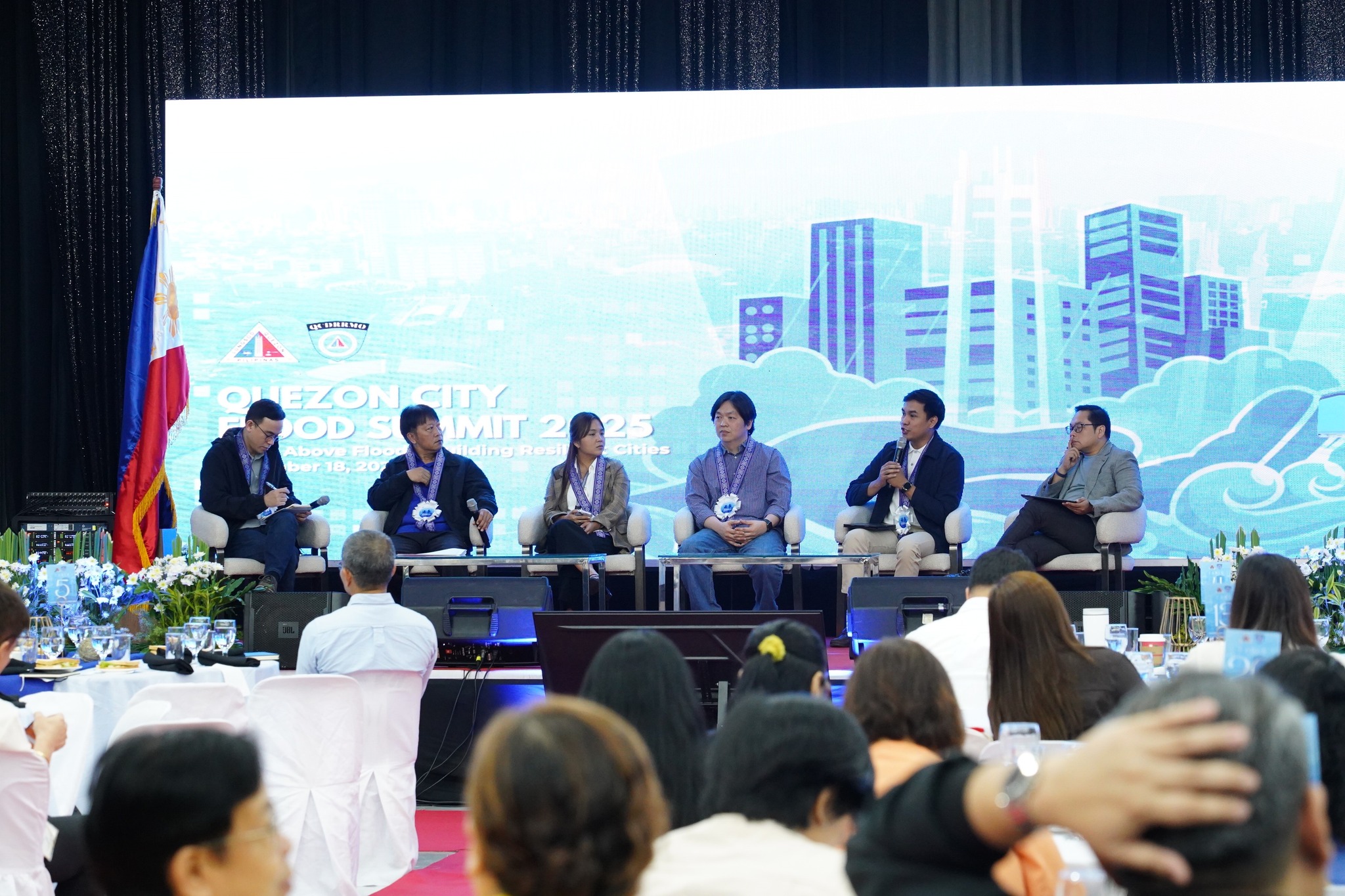
The Quezon City Government, through the QC Disaster Risk Reduction and Management Office (DRRMO), convened leading experts from science, engineering, urban planning, social welfare, and disaster resilience sectors for the QC Flood Summit 2025.
With the theme “Rising Above Floods: Building Resilient Cities,” the summit aimed to address the city’s flood challenges through science-driven forecasting, accountable infrastructure systems, and future-ready urban design.
Mayor Joy Belmonte, in her welcome remarks, underscored the various programs of the city government in addressing flooding, preparing communities for disasters and in building a resilient city.
“Resilience has been thrown around casually in conversations on flooding and disasters, and too often used by those in power as an excuse to avoid accountability. But counting on our people’s resilience is no longer an option. Napapagod na ring maging matatag at matiisin ang ating mga kababayan. They deserve long-term solutions. We must therefore intensify our efforts and strengthen our systems so they can better support our communities in the years ahead,” she said.
The summit’s technical discussions emphasized that improving early warning systems remains one of the most critical priorities for flood-prone urban areas. They underscored the need for more accessible tools, user-friendly hazard maps, and capacity-building programs.
Participants also pointed out gaps between national hazard forecasts and local decision-making timelines. Decisions on class suspensions, work advisories, and pre-disaster mobilization often require action hours before hazards peak, when forecasts still carry varying levels of uncertainty.
To address this, experts recommended aligning protocols between agencies, improving communication channels, and institutionalizing forecast-based action to enhance readiness at the local level.
Beyond forecasting, the summit highlighted the importance of strengthening accountability in infrastructure development. Panelists acknowledged public frustration over failed flood control projects and called for a shift from fragmented, contractor-driven interventions toward basin-wide planning informed by hydrology and environmental science. They recommended engineering innovations that are holistic and nature-based solutions to create sustainable, long-term flood mitigation strategies.
Representatives from PAGASA, the Philippine Space Agency, UP Resilience Institute and UP Institute of Environmental Science & Meteorology, Department of Social Welfare and Development-NCR, Philippine Disaster Resilience Foundation, Department of Interior and Local Government, Philippine Institute of Civil Engineers, United Architects of the Philippines, Palafox Associates, the Embassy of the Kingdom of the Netherlands, San Miguel Corporation, and the Center for Disaster Preparedness shared insights on building a city that is safer, more responsive, and more resilient to extreme weather events.
City Engineer Atty. Mark Dale Perral meanwhile cited the QC government’s findings following the reported failed flood control projects found in the city. “When the flood control projects came out, 99% of the projects ay puro ‘wall’ or creek wall. Pina-pader ‘yung mga creeks and rivers. Ang tanong, may increase ba sa detention capacity ng river? ‘Di ba wala, parang nabawasan pa nga.”
Urban planners and architects further encouraged the city to integrate people-centered design and inclusive development in its future projects, ensuring that resilience extends beyond flood mitigation and into broader livability and sustainability goals.
The summit concluded that collaboration across sectors—government, business, and local communities—is essential to creating future-ready cities equipped to face climate-driven challenges.
The Quezon City Government affirmed that insights from the Flood Summit 2025 will be integrated into its ongoing efforts on drainage modernization, floodplain management, disaster risk reduction, and climate adaptation planning. The summit’s recommendations will also bolster the city’s long-term strategies to enhance transparency, improve coordination, and build inclusive, science-based resilience systems.
“Through this summit, we strengthen our commitment, not only to scientific, nature-based, and resilient solutions to flooding—but to the broader mission of transforming our society into one where nobody gets left behind,” Mayor Belmonte said.
As the city confronts increasingly complex climate and urban challenges, the Quezon City Government assures QCitizens that it will continue to expand investments in resilient infrastructure, strengthen community preparedness, and pursue innovative, data-driven solutions.
Article and photo by the Quezon City Government